

Help! I have been having trouble getting smooth glue fillets on my fins. It doesn't seem to matter what glue I use, I still get a bunch of air bubbles. I don't remember having this big a problem in years past. So, I was hoping some of the great builders out there would share their secrets on good smooth glue fillets. Thanks for any help.
-
Rick Randol
NAR #28062, ROCI Section #625
http://www.indyrockets.org
NewWay Space Models-We Cornered Model Rocketry -
Air bubbles?! When I get air bubbles in some of my builds (and I DO get them from time to
time, so you're not alone), it's usually due to a slightly clogged nozzle of my white glue and
also when the glue bottle is almost empty. Excessive air pockets is being expended as the
glue is applied to the fin/body tube joint. If I see any air bubbles during my builds, I immediately "pop" them and apply a dab of white glue to the spot(s) and smooth the fillet
with my finger again (or repeat the step as necessary until the job is done right).
Hope that helps. I'm sure others will chime in on their theories and solutions (I'm still all
ears!)..... Dave, NAR # 21853 SR.
-
I have noticed that when I use Yellow Glue for fillets it always dries with small holes in it and requires at least a second coat. It makes no difference if I make big or small fillets, there are always holes when the glue dries.
My favorite for fillets is 5 minute epoxy, although some guys will tell you that is over building. I just like the way it flows and sets up. It is also easier for me to hide a small gap in a long fin.
I always tape off my fillets first, leaves a cleaner line. I also use my finger to smooth them out.
JoeComment
-
Oh, no, a GLUE thread!
IMHO 5 minute epoxy has no place in our hobby. I can't imagine anything worse for fillets. It has NO heat resistance, and it is so thick that it can't flow out into a good fillet.Originally posted by GIJoe
If you're building with yellow glue, there is nothing wrong with using yellow glue for fillets. My THOY Hornet (Graduator / Initiator sized rocket) is built with nothing but yellow glue for everything, and has flown repeatedly on H motors.
When I do use epoxy for fillets, or anything else for that matter, its one of the laminating resins (System 3, West, Raka) with a very slow hardener and when appropriate some micro balloons or other additive mixed in.
When I need something that sets faster than medium cure (hour +) epoxy or yellow glue, I use CA, or in certain cases hot melt glue.I fought the law, and the law LOST!Comment
-
I use this stuff. Its viscosity is about half way between white glue and paste. It makes very nice fillets in one application. It does not shrink when drying nearly as much white or yellow glue.
Available at your local home improvement store.
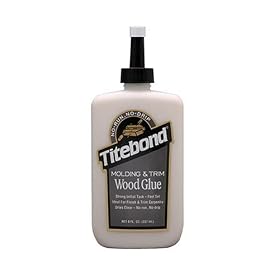
I can't figure out how attach images (as opposed to linking to hosted images) so that's the only picture I can offer.Comment
-
Rick,
Where weight is not a critical issue, I really like
Apogee's Fix-It Epoxy Clay for fillets.
Very easy to use, plenty of working time, makes great looking fillets.
You roll a little bit of the clay into a thin worm the length of the fin, place it where you want the fillet, then run a wet popsicle stick over it to form it to shape. Takes a little practice but makes great looking, very strong, fillets.
For competition models I use thin CA and accelarator.Comment
-
To minimize bubbles, I make a solid bead of glue down the length of the joint, but make the bead small so that I'm not wasting a bunch. I get very few bubbles, but when I do, I just take my x-acto knife aand pop them. The glue will flow back into the holes and level out. This is with both yellow and white glue.Originally posted by Bluegrass Rocket
If I for some reason still end up with a bubble, I simply fill it with fill-n-finish when I'm filling the balsa grain.I love sanding.
Comment
-
I'm with tbzep I have found that storing my glue bottles nozle down helps as well.
Comment
-
Great idea! I should have known about that, as I've seen the sandwich makers at Sub WayOriginally posted by duobob
do that to the mayonnaise/mustard squeeze bottles too.Dave, NAR # 21853 SR.Comment
-
Yellow glue often dries kinda "funny" and seems more prone to leaving gaps or holes. I have sometimes used yellow glue as my first pass fillet, sanded a little and then used white glue on the second pass as more of a gap filler than for any need to add additional strength.Comment
-
Nothing lays down a smooth a fillet as 30-min epoxy smoothed out with a rubber-gloved acetone coated finger.
The rocket has to rest horizontally and only two fillets can be performed at a time.
Second to that is 5-min epoxy, but beware the 5-min epoxy has much less structural integrity. Don't let anyone scare you off 5-min epoxy due to the lousy heat resistance. No Model Rocket or Mid-Power rocket engine burns long enough to even remotely need a heat resistant glue unless the part is in the exhaust stream or is a 29mm min-diameter "G" power bird.
Using "advanced" epoxy glues such as Aeropoxy or West System is a needlessly expensive overkill waste for anything below an average Level 2 J-powered rocket (Warp 9 H and I motors excepted, of course)
If you HAVE to use wood glue, I have found Titebond II (NOT regular Titebond or Titebond III) has the best filleting properties available in a traditional wood glue. Much fewer pin holes if layed on in say 3 thin applications.
Plain old Elmers white glue leaves smoother fillets than any Aliphatic Resin (yellow Titebond-style) Wood Glue.
The absolute WORST yellow aliphatic wood glue for making fillets is Elmers Carpenter's Wood Glue. That stuff is the absolute worst rubbish I've ever used. I'd rather use candle wax for fillets than that crapola.When in doubt, WHACK the GAS and DITCH the brake !!!
Yes, there is such a thing as NORMAL, if you have to ask what is "NORMAL" , you probably aren't !
Failure may not be an OPTION, but it is ALWAYS a POSSIBILITY.
ALL systems are GO for MAYHEM, AGITATION, CHAOS, TURMOIL, FIASCOS, AGGRAVATION, INSTIGATION, NUISANCE-ACTION, and HAVOC !Comment
-
I get more bubbles with white glue than with anything else. I can smooth it down well with my finger and have it looking really nice, and then come back a few minutes later and find bubbles emerging from underneath the fillet. Popping them doesn't totally help, because they never completely fill in afterwards. I have never been able to totally eliminate the bubbles, which is why I rarely use white glue anymore on fins, either for attaching them or filleting them.
I have used Titebond III occasionally for fillets and have had good, bubble-free results most of the time, but I have had bubbles show up in it a few times, too. I'm almost out of it now, so maybe I'll take gh's recommendation and try Titebond II next.
I mostly use 30-minute epoxy for anything 12" long or bigger. Depending on the size of the rocket, I can make the fillets big or small. I wear a nitrile glove and smooth them down with a finger dipped in 91% isopropyl alcohol from Walmart (but now that I have some denatured alcohol, I'll use that for it). Acetone just evaporates too fast and it has a much stronger smell that alcohol, and alcohol works really well on epoxy. I like to use the longer setting epoxy because it is thinner in consistency, allowing it to flow better into the joint and to self-level. I also mask off the fins (when I remember to do so! ) , which, as GIJoe mentioned, makes for a cleaner, neater fillet. You just have to be sure to pull off the tape mask as soon (within a few minutes for 30-min. epoxy) as you have smoothed the fillet down! To keep the weight down on smaller models, I go pretty thin with the epoxy, wiping most of it off with my finger, and then I keep applying thin coats like that to build up the fillet to where I want it. I never ever get bubbles with epoxy.
If I want to make big beefy fillets on big models, or if I just want to be able to sand the fillets, I mix in Sig microballoons into it, which causes the mix to resemble paste or spackle while reducing its weight. This makes it easier to slather on big, thick fillets on those rare occasions when I need them, and it keeps their weight down. Microballoons also make the cured epoxy easy to sand. With this kind of mix, it is really important to mask off the area around the fillet, because the stuff really oozes out when you smooth it, and where it goes, it tends to stay. I'm trying to remember to do the masking myself, but it isn't a fully-developed habit yet. I will sometimes use a microballoons-epoxy mix sparingly on smaller models when I want to have a sandable fillet, and also sometimes to patch bubble holes or gaps in an existing fillet, especially if they are big. (I have also used Fill 'N Finish for this.)
On smaller models, I have been increasingly using BSI Maxi-Cure CA, swiping it very quickly with my gloved finger, waiting about a minute or so, and then hitting it with a heavy spray of BSI Insta-Set accelerator. When it is allowed to cure naturally, Maxi-Cure leaves a somewhat soft, flexible, rubbery and milky-looking fillet, but if you cure it with Insta-Set it turns glass-clear, smooth and hard as a rock! The downsides with using it are that you can't mask off the area around the fillet, you have to be quick about smoothing it (and you have to have a saturated sponge sitting in a small bowl of acetone nearby to use to wipe your gloved finger off between swipes), and you have to use fresh, just-purchased and just-opened Maxi-Cure to get the best results. You also have to keep your bottle of Insta-Set in a different room from where you apply the CA, and be ready to run to the other room with your rocket to spray it with the accelerator, in order to keep the mist from coming anywhere near your open bottle of CA. And then, after wiping off the overspray, you need to leave the model in the same room as the Insta-Set while you go back and close up your CA bottle (ideally, after you have removed your smock and gloves and left them behind!
 ).
Mark \\.Mark S. Kulka NAR #86134 L1,_ASTRE #471_Adirondack Mountains, NY
Opinions Unfettered by Logic • Advice Unsullied by Erudition • Rocketry Without Pity
+09281962-TAK-08272007+SAM # 0011
Comment
-
Thanks for all the help guys. I am going to try some different techniques and glues. I was using Elmers Carpenters Wood Glue and I think I'm with GHRocketman, it ain't good.Rick Randol
NAR #28062, ROCI Section #625
http://www.indyrockets.org
NewWay Space Models-We Cornered Model RocketryComment
-
Just make sure that, whatever you use, you smooth it down after you apply it. If the project is anything smaller than high power, that means using your finger, but make sure that it doesn't have any dried glue, paint, sawdust, etc. on it first, and that you wet it right before touching the fillet. For anything other than white or yellow glue, wear nitrile gloves (latex gloves don't provide enough of a barrier, and vinyl gloves are too loose). Use water for white glue or yellow glue, alcohol (or acetone) for epoxy, and a very light amount of acetone (or else nothing at all) for CA (don't use debonder!). I'm not sure what is needed for Fix-It clay, because I've never tried it. If it is epoxy-based, then gloves and a little denatured alcohol (probably) are what you would use.
And, as Tim mentioned, you can always patch any holes with FNF or putty. Once the fillets are covered with paint, no one will be able to tell.
Mark \\.Mark S. Kulka NAR #86134 L1,_ASTRE #471_Adirondack Mountains, NY
Opinions Unfettered by Logic • Advice Unsullied by Erudition • Rocketry Without Pity
+09281962-TAK-08272007+SAM # 0011
Comment
-
I've learned that to prevent bubbles in elmers... I soak the bottle in hot water, then apply while the glue is warm...Comment


Comment